So the other day, on a whim, I went looking to see if I could find the exact purchase price of an EMD SD40-2. Couldn’t find much, but I did find this interesting little tidbit about the Louisville & Nashville getting sold an order of SD40-2s to a different railroad’s specifications, because they needed power and EMD refused to accommodate their request. To quote the author, whose username is “NYSWSD70M”:
As I have stated in a previous post, CSX was upset with EMD over more than the SD50 issues. I was working with (not for) CSX’s motive power people at the time of the big switch to GE vs EMD. The years of EMD’s way or the highway had worn thin. CSX would admit when they were in private, it was not the product, it was the attitude. When GE’s product became viable, the customer base revolted against EMD. Sometimes the extent of the revolt depended on how good (or bad) the local EMD people were.
As an example of what had upset the customers, in the late SCL/L&N Family lines days, the L&N desperately needed an order of SD40-2’s. EMD accepted the order but built them to another carriers spec and wouldn’t price them until they were completed. EMD knew they had them over a barrel and took advantage of the customer. Unfortunately, the customer had a long memory.
This piqued my interest, as I have been enamored of late with the often minute changes in locomotive specifications between railroads, and I especially love researching “oddball” locomotives–units that had unusual or specific alterations made to suit peculiar needs.
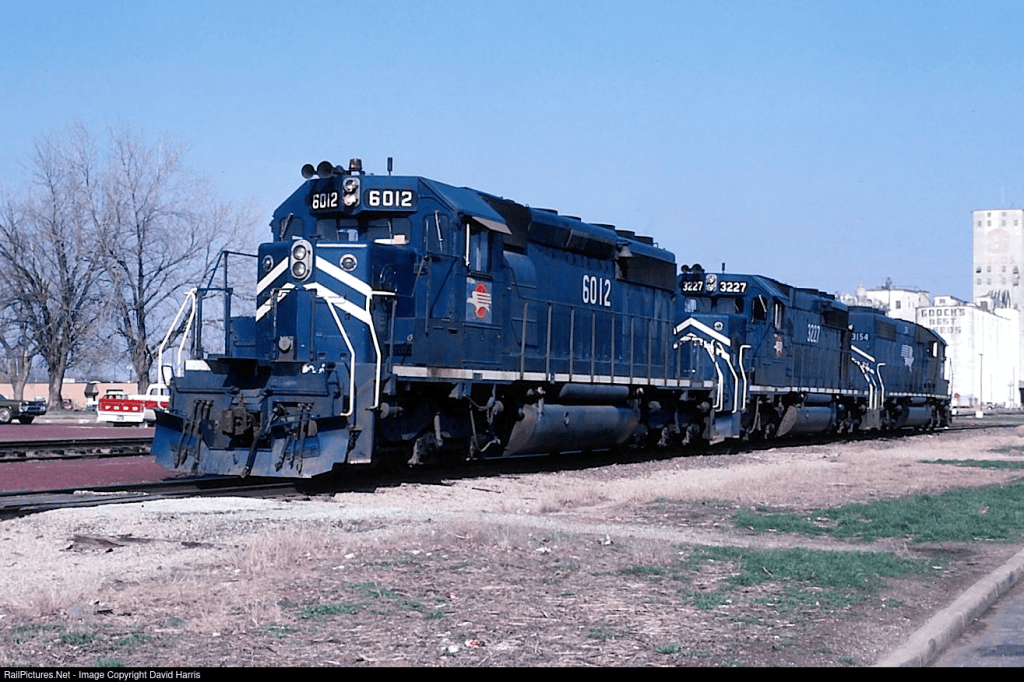
As an example, the Missouri Pacific Railroad (MoPac) had a number of “SD40-2c” units in their larger SD40-2 fleet, that were initially purchased for joint coal trains with the DRGW and Burlington Northern. These units had dynamic brakes, an unusual feature for the flatland-running MoPac, and the initial order even had DRGW-style oscillating headlights in the nose as seen below:
L&N specifications were, among other things, a headlight mounted in a cutout in the nose of the locomotive, with an oscillating light mounted in the usual headlight position above the cab, and it was this feature that I was most curious to investigate on the Mystery Motors. The “late SCL/L&N Family lines [sic] days” was a period in the late 1970s and early 1980s wherein the L&N, owned by the Atlantic Coast Line railroad since 1902, began to disappear as an independent entity; the number of twists and turns in the story of that consolidation is far too great to enumerate them all here, but I will say that the specific order would likely have fallen between 1977 and 1982.
I began my search on the Unofficial EMD Homepage. A fantastic resource for the passionate diesel modeler or enthusiast, this website lists just about every locomotive made by the Electro-Motive Division of General Motors in its entire history, with build date (month and year), reporting mark and road number, and builder’s numbers for every single one. Many of them have the as-delivered weight as well, which is something that often changed per railroad or even per order; those MoPac “SD40-2c” units for instance, like the 6012 above, tipped the scales at 417,000 pounds, while the road’s general-service units (exemplified by the 3227 and the trailing 3154 above) weighed in at a more modest 385,000-391,000 pounds.
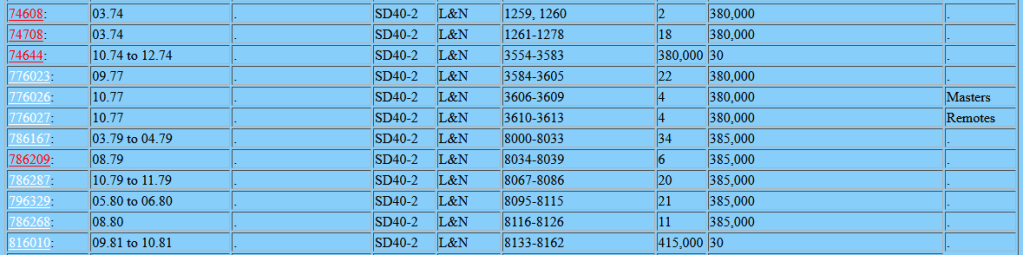
And herein was my first clue to the L&N Mystery Motors. While 1974 and 1977 SD40-2 orders were built to 380,000 lbs weight, an extra two-and-a-half tons appeared starting in 1979 (with the railroad’s final order nearly reaching the coal-hauling weight of the units above, at 415,000 lbs).
Time, then, to find pictures!
Initial efforts proved unsuccessful, unfortunately. My go-to website, rrpicturearchives, recently underwent a redesign of some of their web pages, and I have found it significantly harder to actually find what I’m looking for, quickly. I’m getting used to it, though, and was able to massage it to produce some results–specifically, decidedly normal L&N locomotives.
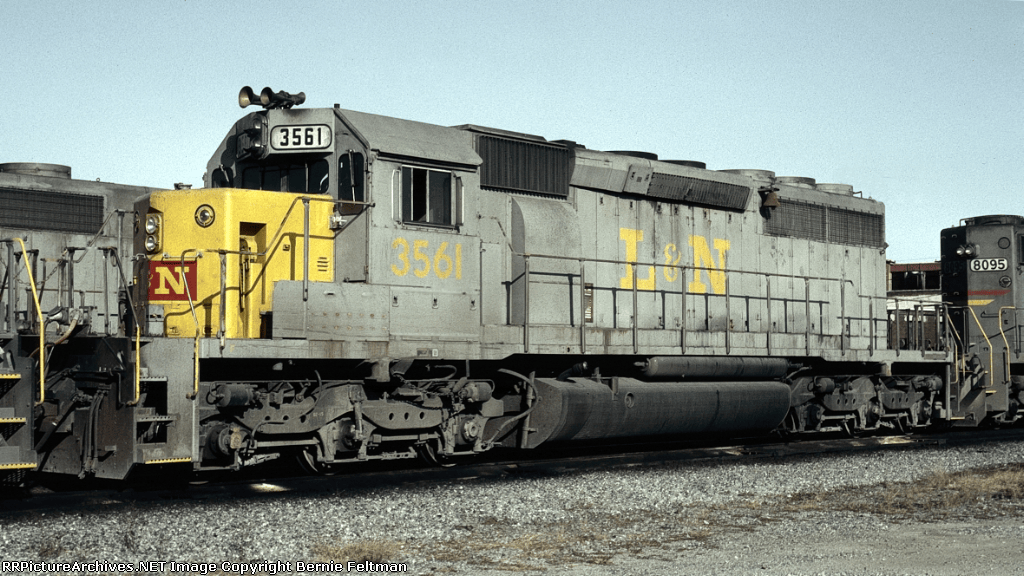
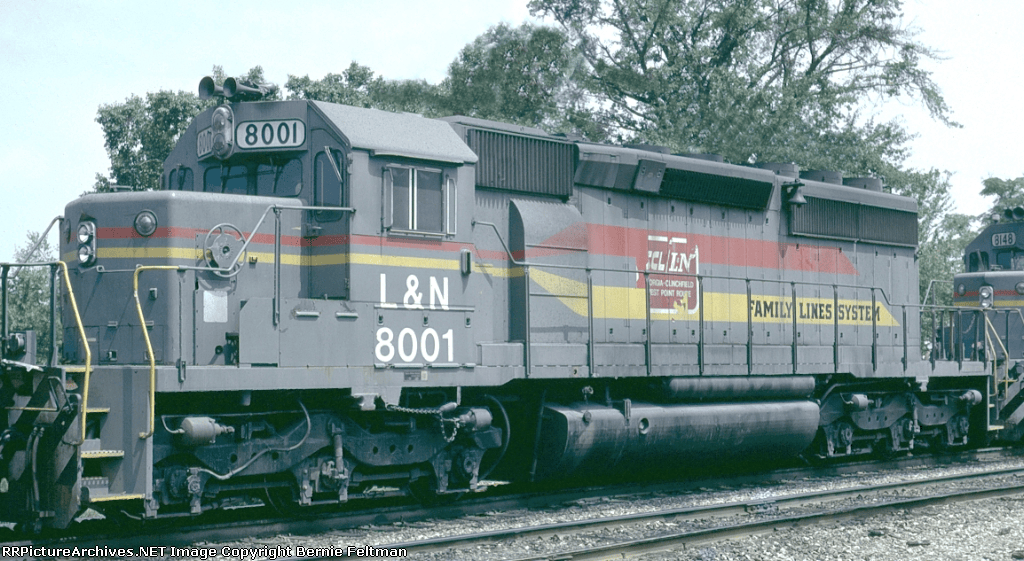
Besides the five years of production and corresponding design tweaks (different radiator, for instance) and a wheel-style handbrake instead of the ratcheting brake on the 3561, the units are nearly identical. Same 5-chime Leslie horn, same headlight configuration, cab window arrangement, MU plug location, bell placement, etc. Most likely, then, it was not the weight of the units that was the specification EMD refused to budge on. Back to searching.
After a good half-hour of looking at road numbers, I went back to Trainweb. Maybe there was a detail I’d missed? The road number series lined up, the weight was the same, the build date lined up, so…what could it be?
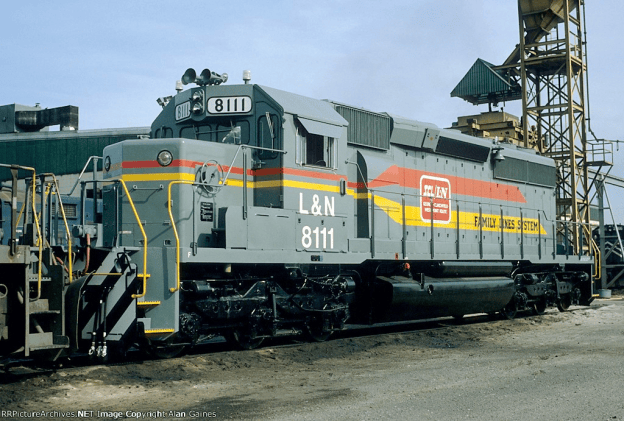
As often happens with my research, it was actually rather obvious in hindsight. The Unofficial EMD homepage categorizes orders by–what else–order numbers. And L&N’s orders of SD40-2s in 1979 and 1980 were in the 786xxx series of EMD order numbers, with one notable exception: an order of 21 units built in May and June of 1980, under order number 796329. These were delivered to L&N as numbers 8095 through 8115, and–after more digging on rrpicturearchives–I was able to find a picture of L&N 8111 fresh from the factory:
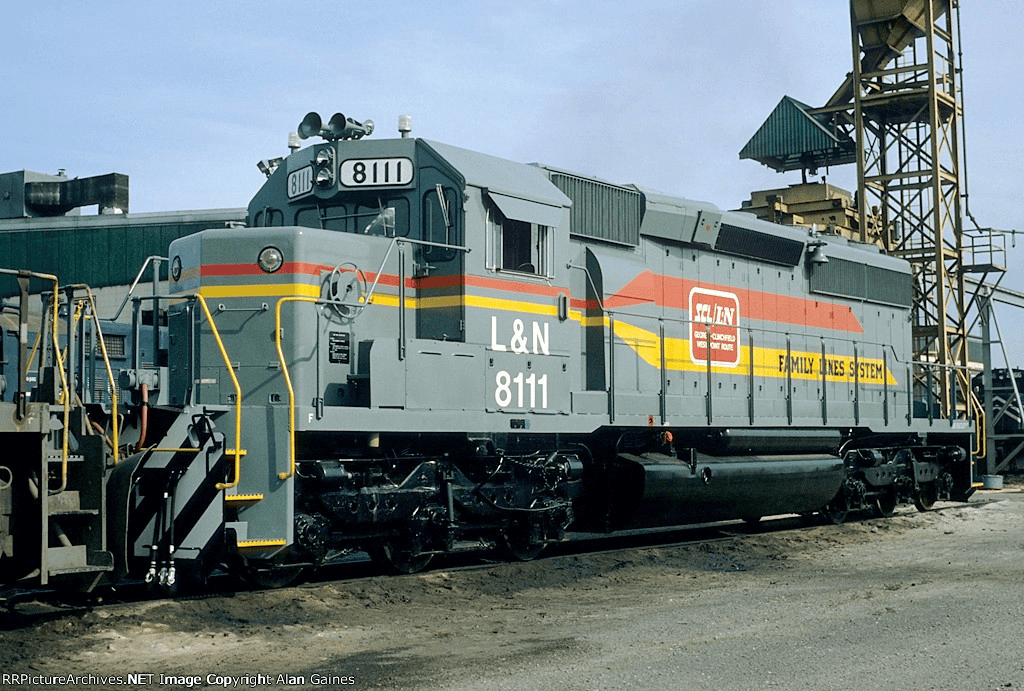
Sure enough, she is missing the signature cut-out nose headlight! A clear sign that she was not built to L&N specifications. And that’s not the only difference; the 8111 looks to have extended-range dynamic brakes, as evidenced by the fatter blister just ahead of the vent grille, and she has a pair of white beacon lights on top of the cab. L&N 8081, meanwhile, built just 6 months earlier, has standard dynamic brakes and nothing on the cab roof but a horn (and presumably a radio antenna), in addition to the classic L&N light package:
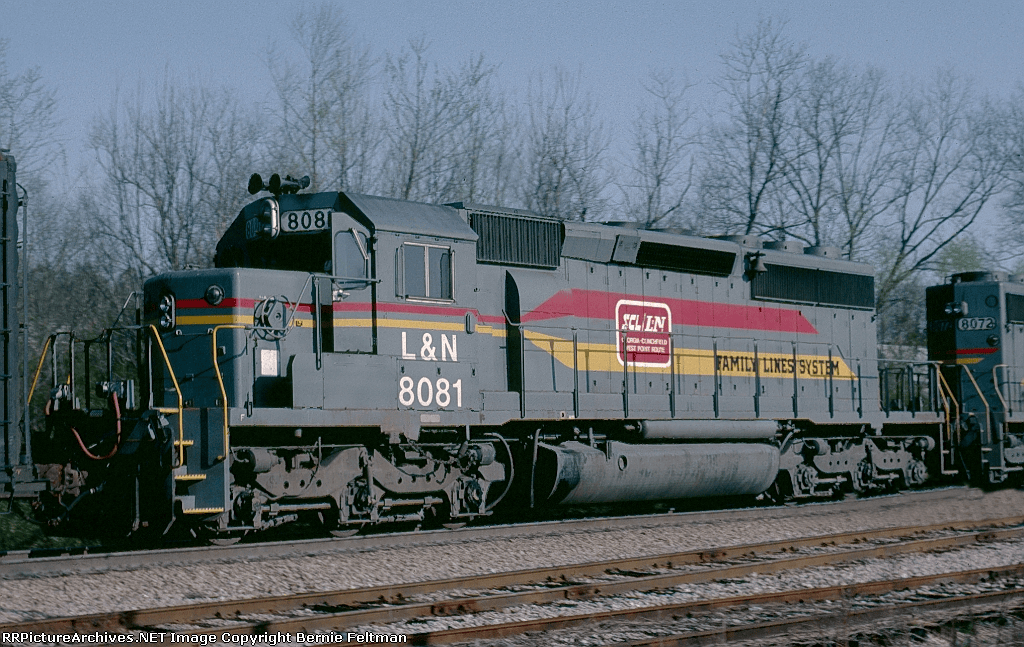
So that confirms it: there was indeed an order of SD40-2s delivered to the L&N that were not built to their specifications. L&N 8095-8115 were instead a product of EMD’s frankly disdainful and obstinate attitude toward a customer in need, rather than any actual request.
Now. My curiousity when it comes to these things is very rarely sated with one layer of answers. Naturally, I then decided to see whether or not I could figure out for which railroad these imposter L&N units were originally destined.
The closest order number numerically was order no. 796327, 4 SD40-2s for the Soo Line, but they look radically different than the L&Ns: no dynamic brakes at all, a shorter fuel tank, a winterization hatch of the front cooling fan, “all-weather” cab windows (a common feature on railroads that had to contend with the harsh winters of the Upper Midwest), and a three-chime horn mounted right above the engineer’s seat instead of a big five-chime front and center.
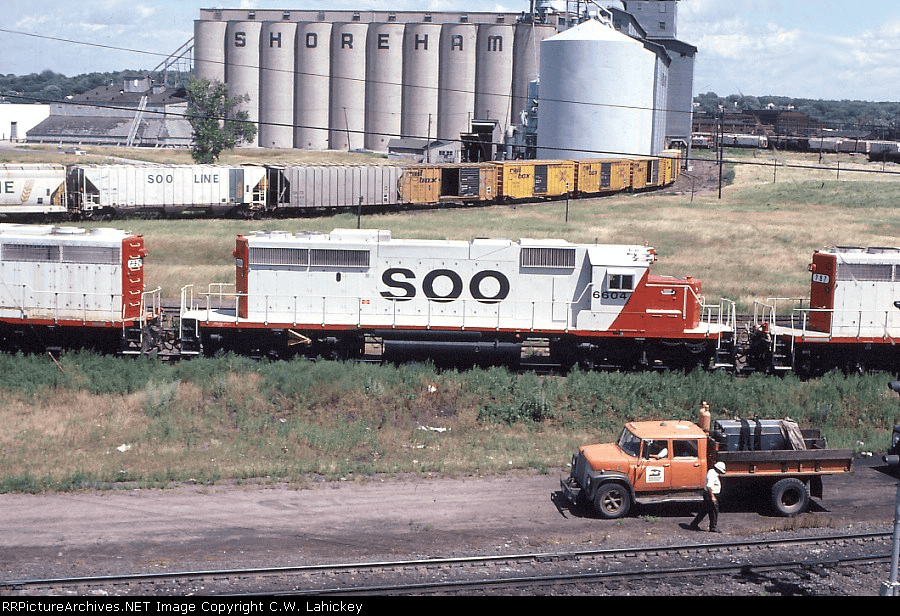
Those L&N units were most likely not initially destined for the Soo, then.
The next-closest order was 796334, 8 units for the SCL (8087-8094), but these didn’t quite match up either; they had the SCL- and L&N-specified nose-mounted headlight, but also had the cab roof beacons and extended-range dynamic brakes, all features that would show up again on SCL’s next order of SD40-2s. My best guess, then, is that these features were actually specified by the SCL, rather than an EMD imposition.
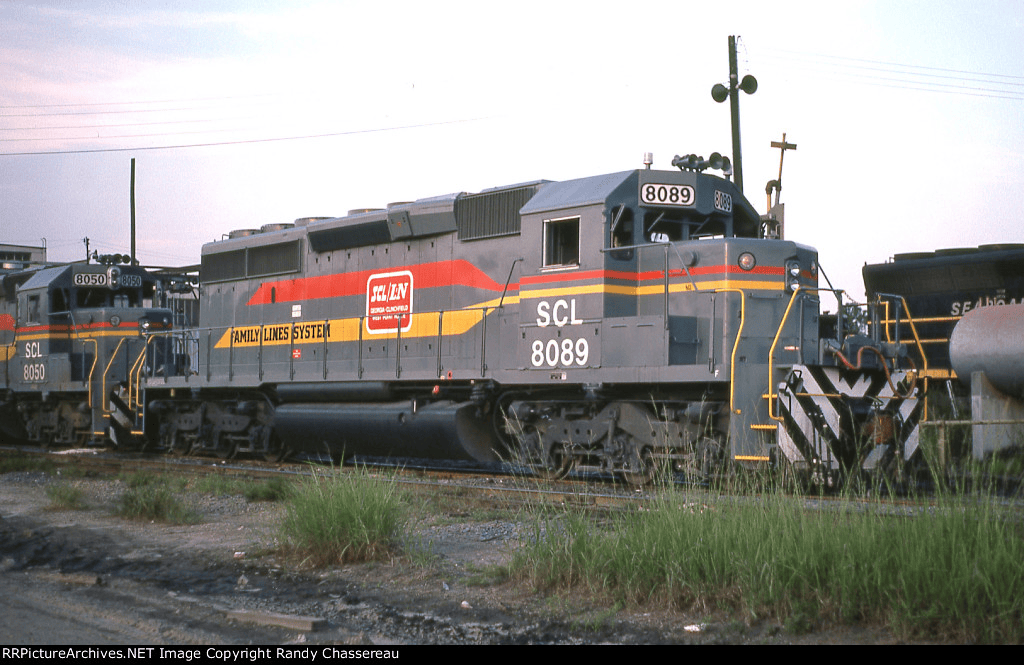
This was around the time that the SCL and the L&N were finally actually merging into a single operating entity, creating the Seaboard System as an official railroad, so no doubt there was a great deal of overlap in specifications. Because the railroads’ paint schemes had been unified several years prior, though, it’s often difficult to tell in this era which railroad actually legally owned which units, especially since the SCL (who had been calling the shots for both railroads since practically the turn of the 20th Century) made sure the road number ranges would be in sequence for the upcoming merger.
Case in point: L&N’s first 1979 orders, numbered 8000-8039, were followed by 8067-8086, leaving 8040-8066 apparently vacant; a quick look at SCL’s first order of SD40-2s, though, yields those exact road numbers with an SCL reporting mark. Since both railroads’ engines would bear the “SBD” reporting mark within a mere handful of years (and then, very soon thereafter, “CSXT”), it’s clear to me that this was just the SCL planning ahead.
Another thing, which I just discovered doing research for this very post, is that L&N’s next order, nos. 8116 to 8126, also had the same quirks as the 8095-8115–namely the high headlight instead of the nose cutout, the extra dynamic brake bulge, and the odd beacons either side of the horn. But this was order no. 786268, which is pretty much in line with the rest of L&N’s late SD40-2 orders and one number above a DB-less Mopac order.
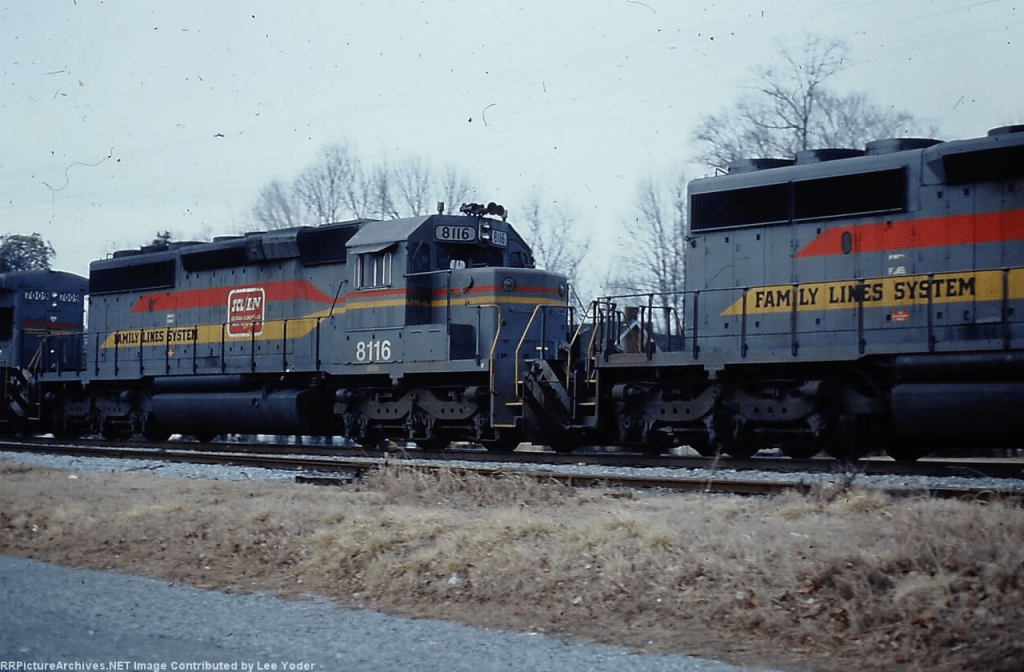
The closest I can find to this order is order no. 796297, which was 110 units for the Union Pacific in March of 1980. The extended-range DB is there, and the headlight is indeed on the cab instead of in the nose, but the cab roof details are different and there’s only one MU cable stand, rather than two on the L&N units. Unfortunately I could not find a good three-quarter angle in the time I had to research this article, so here’s the best I could find:
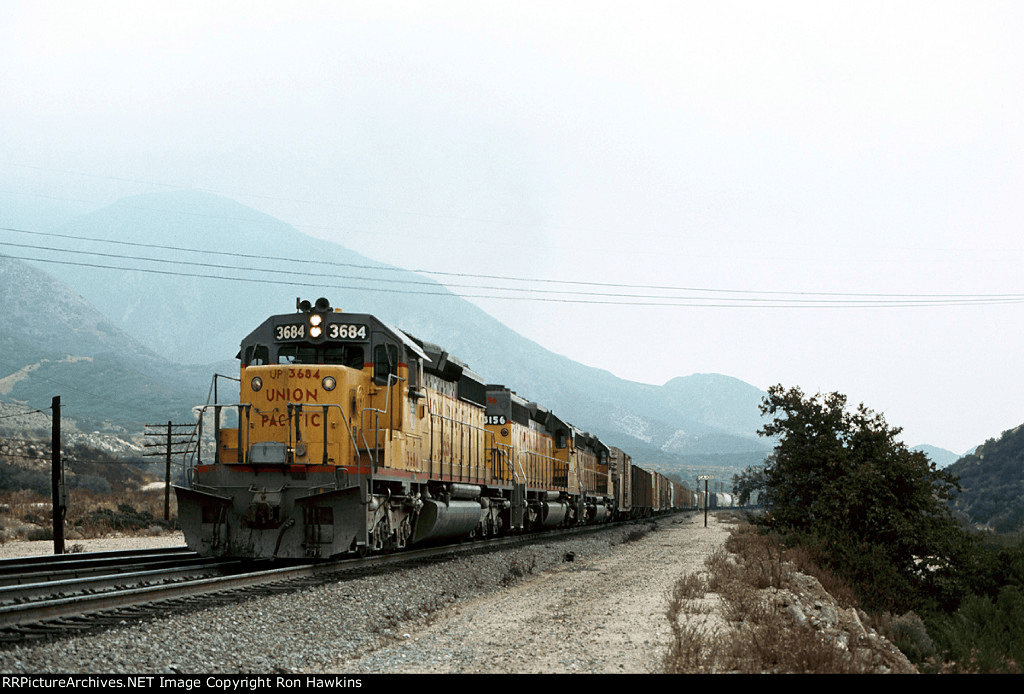
Anyway, we (read: I) may never know what the real incipience of these locomotives was; whether they were to be BN Powder River Basin coal haulers, UP mountain goats, or they were just the result of EMD’s intransigence. But in the era before US railroads consolidated to the point of practical monopoly, and railroads still had their own unique individual requirements beyond just a paint scheme, I thought this was a fascinating peek behind the curtain at the process of purchasing locomotives, and how it isn’t always “build-to-suit”. Sometimes you get what you pay for; other times, you just have to take what you can get.
All photos credited to original authors, as stated.

